Investigation on Active Vibration Isolation of a Stewart Platform With Piezoelectric Actuators
Contents
- Tags
- Stewart Platforms, Vibration Isolation, Flexible Joints
- Reference
- (Wang et al. 2016)
- Author(s)
- Wang, C., Xie, X., Chen, Y., & Zhang, Z.
- Year
- 2016
Model of the Stewart platform:
- Struts are treated as flexible beams
- Payload and the base are treated as flexible plates
- The FRF synthesis method permits to derive FRFs of the Stewart platform
The model is compared with a Finite Element model and is shown to give the same results. The proposed model is thus effective.
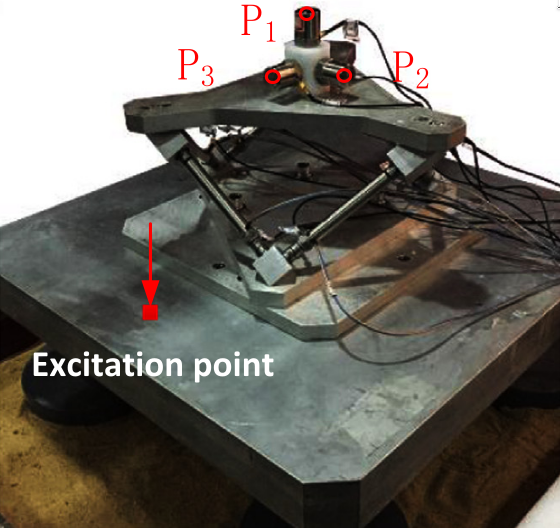
Figure 1: Stewart Platform
Control: Combines:
- the FxLMS-based adaptive inverse control => suppress transmission of periodic vibrations
- direct feedback of integrated forces => dampen vibration of inherent modes and thus reduce random vibrations
Force Feedback (Figure 2).
- the force sensor is mounted between the base and the strut
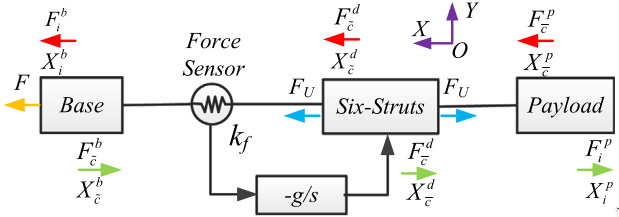
Figure 2: Feedback of integrated forces in the platform
Sorts of HAC-LAC control:
- LAC: Decentralized integral force feedback
- HAC: Inertial control using accelerometers. Use of the Jacobian to decouple the motion and then Fx-LMS based adaptive control is used
Experimental validation:
- All 6 transfer function from actuator force to force sensors are almost the same (gain offset)
- Effectiveness of control methods are shown
Bibliography
Wang, C., X. Xie, Y. Chen, and Z. Zhang. 2016. “Investigation on Active Vibration Isolation of a Stewart Platform with Piezoelectric Actuators.” Journal of Sound and Vibration 383. Elsevier BV: 1–19. doi:10.1016/j.jsv.2016.07.021.