Multivariable Control
Contents
- Tags
- Norms
A very nice book about Multivariable Control is (Skogestad and Postlethwaite 2007)
Transfer functions for Multi-Input Multi-Output systems
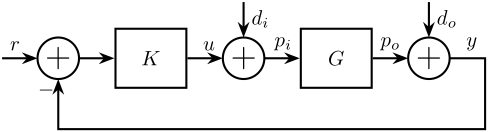
\[ T_i = -\frac{u}{d_i} = (I + KG)^{-1} KG \] \[ T_o = -\frac{p_o}{d_o} = (I + GK)^{-1} GK \] \[ S_i = \frac{p_i}{d_i} = (I + KG)^{-1} \] \[ S_o = \frac{y}{d_o} = (I + GK)^{-1} \]
Measures of interaction
- Interaction index (for \(2 \times 2\) plant): \[ \phi = \frac{g_{12}g_{21}}{g_{11}g_{22}} \] When \(\phi\) is close to zero, this means there is no interaction.
- The relative gain array of a square matrix: \[ \text{RGA}(G) \triangleq G \times ( G^{-1})^T \]
Stability
- Characteristic Loci: Eigenvalues of \(G(j\omega)\) plotted in the complex plane
- Generalized Nyquist Criterion: If \(G(s)\) has \(p_0\) unstable poles, then the closed-loop system with return ratio \(kG(s)\) is stable if and only if the characteristic loci of \(kG(s)\), taken together, encircle the point \(-1\), \(p_0\) times anti-clockwise, assuming there are no hidden modes
Bibliography
References
- Decentralized and decoupled control
- Implementation challenges for multivariable control: what you did not learn in school!
- Multivariable Feedback Control: Analysis and Design - Second Edition
- Simultaneous, fault-tolerant vibration isolation and pointing control of flexure jointed hexapods
- Tensor methods for mimo decoupling and control design using frequency response functions
Links to this note
- Decentralized and decoupled control
- Decoupled Control
- Implementation challenges for multivariable control: what you did not learn in school!
- Multivariable Feedback Control: Analysis and Design - Second Edition
- Simultaneous, fault-tolerant vibration isolation and pointing control of flexure jointed hexapods
- Tensor methods for mimo decoupling and control design using frequency response functions